
My Grandmother’s Shoes 2

Share this article

One hip pressed against the wall, her palm warm on my shoulder to steady herself, she’d ease out a square  leather case with silver fittings glittering at the corners. It had one of those swing-down catches with a little crooked tooth. The tooth snugged into a metal loop on the front. We’d sit down on the stairs, knees touching, the box between us. She’d nod and gesture ‘go ahead’ with two fingers. I’d wipe my hands on the lap of my brick-patterned skirt then gently brush time’s dust off the top with the hem of my blouse, swing up the silver hook and lift the lid.


She’d usually turn away for a while to stare over my head at something I couldn’t see. I’d guessed perhaps she was seeing ghosts, but when I looked up the stairs, there was nothing there. 


“My mother was a dainty woman,” Mom would say softly, wiping her eyes with the corner of her apron, not looking at me.


Somehow, my self-absorbed self understood that I should be reverent, that I shouldn’t rush. So we’d sit in the dusty quiet and stare into the shadows of the box, waiting. I shivered when I touched the flimsy wrappings, held loosely with thin faded ribbons or plain parcel string, knowing they held her memories. The rustling papers stirred up a confusion of scent – lavender, lemon, rose and then leather.


I lifted out the treasures, one by one. A thin Blessed Virgin Mary cradling baby Jesus between her ivory arms. Packs of brittle greeting cards with stained edges, red-striped airmail letters cramped with Dad’s blue-black writing, over-stamped with ‘Allied Forces Overseas’. A carved wooden Sphinx the size of my hand, branded ‘made in Egypt’. Three faded roses bound with lace to a slim silvery wrist-band. A dark brown baby shoe worn down at the heels. 


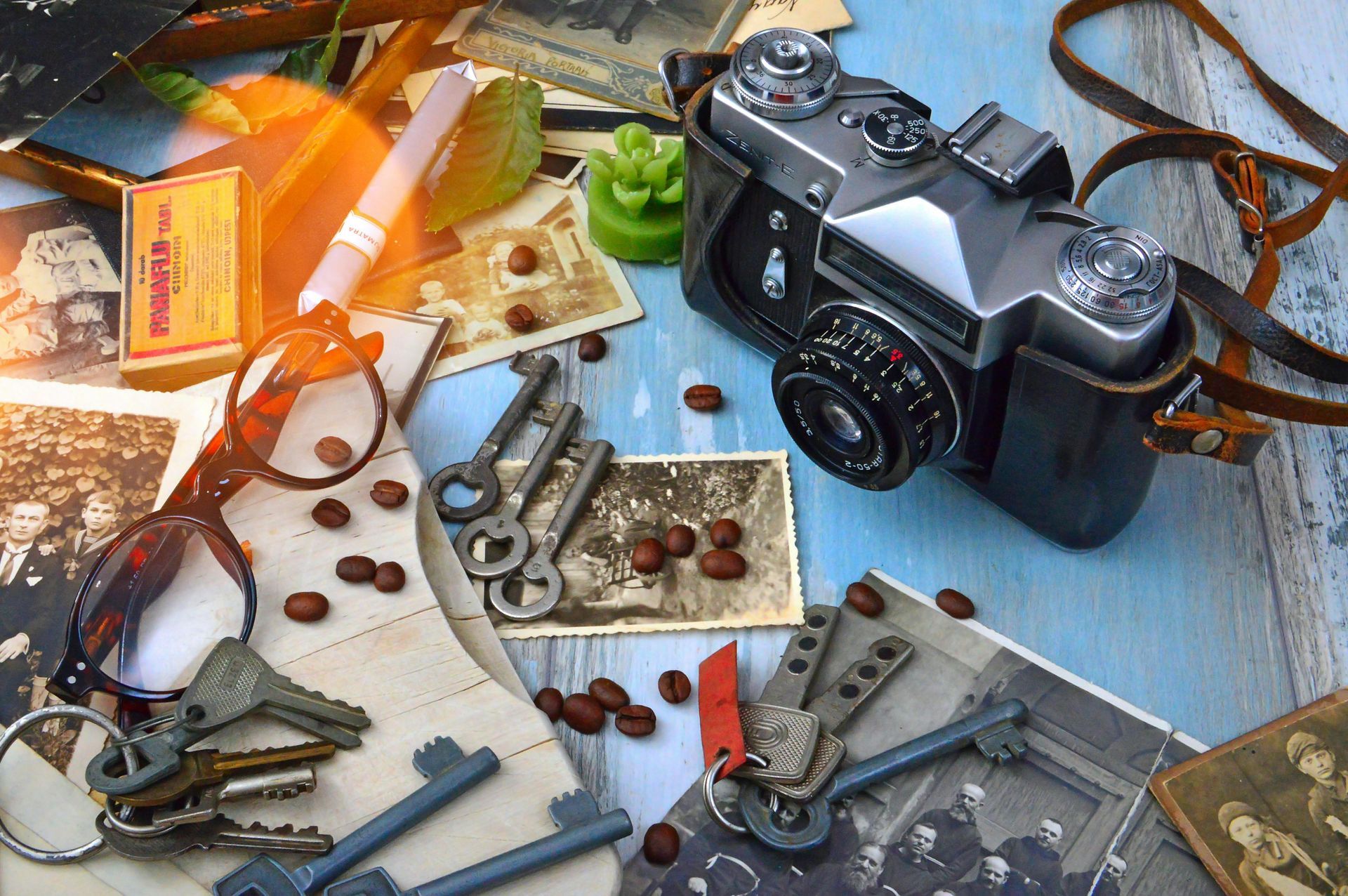
I picked up a photograph tucked against a corner. The date in the pinked margin read February 1938. The camera had caught her dark oval face and her unblinking gaze under a solemn brow. Grandmother’s thick wavy hair was pinned up under a fancy hat. Her fingers gripped the back of a velvet chair. Less than 12 months later, she would sit in a dentist’s chair for a wisdom tooth extraction and not awaken from the anesthetic. My mother was 19 years old, guardian three young siblings to keep safe from the social service authorities who wanted them sent to an orphanage. She bore the weight of that death all of her life. I know that now. 


In comparison, the box that lay in my damp hands was feather-light.


I’d peel back the layers of tissue and there they were – my grandmother’s shoes. They were tiny – size 4, I think – black, with 18 shiny leather buttons marching from the arch to the ankle. They were creased but hardly worn, just enough to give off that comforting used smell. The heels were the width of three of my fingers, about two inches high. I traced the seams and fancy threading along the tongues. I gleaned the cobbler’s name on the instep with my fingers, as if the words were Braille: Savage Shoes. There was no question of me putting them on. At age eleven I was almost as tall as my mother. Already my feet were bigger than hers.


Mom would sometimes pick up a packet of letters and fan through them like they were leaves, only with writing. I remember asking her what they were. She’d said, “Your father wrote such beautiful poetry to me when we first met,” with a sad profundity even I could comprehend. And I would look from her beautiful chapped hands that were almost never still, to the mute epistles in her lap, wishing I could know what she was thinking, what she was wishing. My eyes would feel hot and full and my ears would throb.


We would rest there on the steps until my brothers banged through the screen door or the milkman came or the telephone rang – two long, two short. Too short. Then she would motion for me to put everything away. She’d push the box back into the shadows, snap off the light and close the door with a sigh. I would sigh too, my skinny shoulders rising and falling in time with hers. Leaning against the step, she would fold me to her chest, the sweet powdery smell of her body filling my nose, displacing the scent of our pasts.


Back then I thought it odd that she never wanted to hold my Grandmother’s ‘good’ shoes. But when my mother died too soon, I began to understand the power of possessions so personal.


Even today, when I venture to our storeroom to go through the things that I’ve stored since her passing, they hold a resonance that brings back that pulsing throb, the thickness in my throat, the tremor of longing in my fingers. Oh, Mom. 


I tuck them back into their boxes and seal the lids with fresh tape. Perhaps next year I’ll try again.

Recent Posts

by Hyacinthe Miller 15 June 2026
using Memory to Serve the Story
by Hyacinthe Miller 11 June 2026
put Ordinary People into Extraordinary Situations
by Hyacinthe Miller 6 June 2026
Writing Tip
by Hyacinthe Miller 3 June 2026
Conflict fuels story
by Hyacinthe Miller 30 May 2026
COnflict Matters
by Hyacinthe Miller 28 May 2026
Riding the Short Story Rollercoaster
by Hyacinthe Miller 25 May 2026
Just finish...
by Hyacinthe Miller 22 May 2026
The struggle is real!
by Hyacinthe Miller 17 May 2026
You won't finish if you don't start.
by Hyacinthe Miller 22 April 2026
Passion is defined as a powerful emotion or intense feeling about some one or some thing . It can be positive, like joy or romantic attraction or negative, like anger or avarice. We often talk about passion as though it's a luxury, something to pursue once the practical business of living is settled. Or if someone is passionate about music or art, the environment or, yes, writing, that passion is somehow over the top or not quite proper. But passion has a way of refusing to wait politely in the corner. Plus, passionate people usually are interesting. Write passion into your stories with energy. Don't censor yourself or hold back - you're creating characters with a range of emotions, wants and needs. When you edit your work, make sure you've seasoned the story with elements of passion. That's what readers want to see on the page. Stop for a moment and think about what kind of passion would make you sit up and pay attention. It might be a hobby you set aside years ago but still think about, or a person or project you wish you had not abandoned. Who was that special person who influenced how you see the world? Books that opened your mind in ways you could not have expected? A work of art that made you stop in the middle of a museum and catch your breath? A piece of music that brought you to tears? Passion is all around us, if we simply take the time to stop and hear or see it. It doesn't have to be explosive or shocking, either. Let's be curious about the world around us. It's never too late to let passion be the plot twist in your life story, the unexpected turn that reframes everything that came before it. For me, writing fiction has been exactly that — a thread I kept returning to, no matter how many other obligations filled my days. The first story I wrote was called Whiffy the Skunk. I remember reading it to my younger brothers, and how satisfying it was for my ten year old self to hear their laughter. When they asked for more stories with bigger adventures, I knew that I'd found my calling. I was a writer. Creative possibilities don't announce themselves with fanfare. They appear quietly, as a pull toward something you can't quite stop thinking about. Pay attention to that pull. It knows where your story is going.
Show More